


The awards handed out at a film festival are meant to recognize great work.
At the Las Cruces International Film Festival, they’re also meant to be works of art themselves.
That distinction is by design.
From the beginning, founder Ross Marks envisioned the festival as more than a celebration of film, a showcase for the full scope of the region’s creative identity. Music, dance, visual art, all of it has a place. Even the awards.
“I love the fact that at the awards show, we’re going to have the NMSU mariachi band and the NMSU folklorica dancers,” Marks said. “We’ll be supporting music and dance, so we're just really trying to be a mouthpiece for the arts in southern New Mexico.”
That vision found a natural partner in Theresa Basaldua.
Basaldua has spent a lifetime in the arts.
A former art director at the Las Cruces Bulletin and later a designer at Wilson Binkley advertising, she eventually stepped away from agency work to focus on creating — particularly jewelry — alongside her husband, Daniel. The two met in a high school art class, a shared foundation that continues to shape their work today.
At New Mexico State University, Basaldua immersed herself in as many disciplines as she could.
“While I was there I couldn't stop taking classes,” Basaldua said. “You had to choose an emphasis, but I was doing graphic design, and then I did metalsmithing, and jewelry, and then I did photography, and I was taking drawing classes. I just love every area.”
That curiosity — that refusal to stay in one lane — would later shape the way she approached something unexpected: awards.
The connection came through a chance meeting with a colleague.
While working at her booth at the Las Cruces Farmers’ Market, Basaldua reconnected with Marks. The two had previously worked together during the White Sands International Film Festival, a smaller predecessor to what would become LCIFF.
“Before I did the Las Cruces International Film Festival, I did a little festival called the White Sands International Film Festival for about three years,” Marks said. “Then I stepped away and they ran it for one year before it went away.”
When Las Cruces approached Marks about launching a new festival, he agreed — with one condition: it would be tied to New Mexico State University.
As the festival grew, so did the desire to elevate every part of the experience.
That included the awards.
By then, Basaldua had already begun experimenting with custom pieces.
What started with jewelry evolved into something broader — creating handcrafted awards for local events, from tennis tournaments to pool leagues.
“My brother is the coach of the tennis team in Alamogordo, and he'd ask me to come up with something, so I started making random awards,” she said. “Then, my husband and I played pool league for several years here in Cruces and I started doing awards for some of the pool tournaments as well, so that sort of started building up, and I was making more and more.”
Marks saw the potential immediately.
What if the awards themselves reflected the same creativity the festival was built to celebrate?
In 2025, Basaldua took on the challenge — creating every award for the festival by hand.
There are two distinct types: one set for filmmakers and another for the festival’s high-profile guests. Each piece begins with an idea rooted in the culture of southern New Mexico.
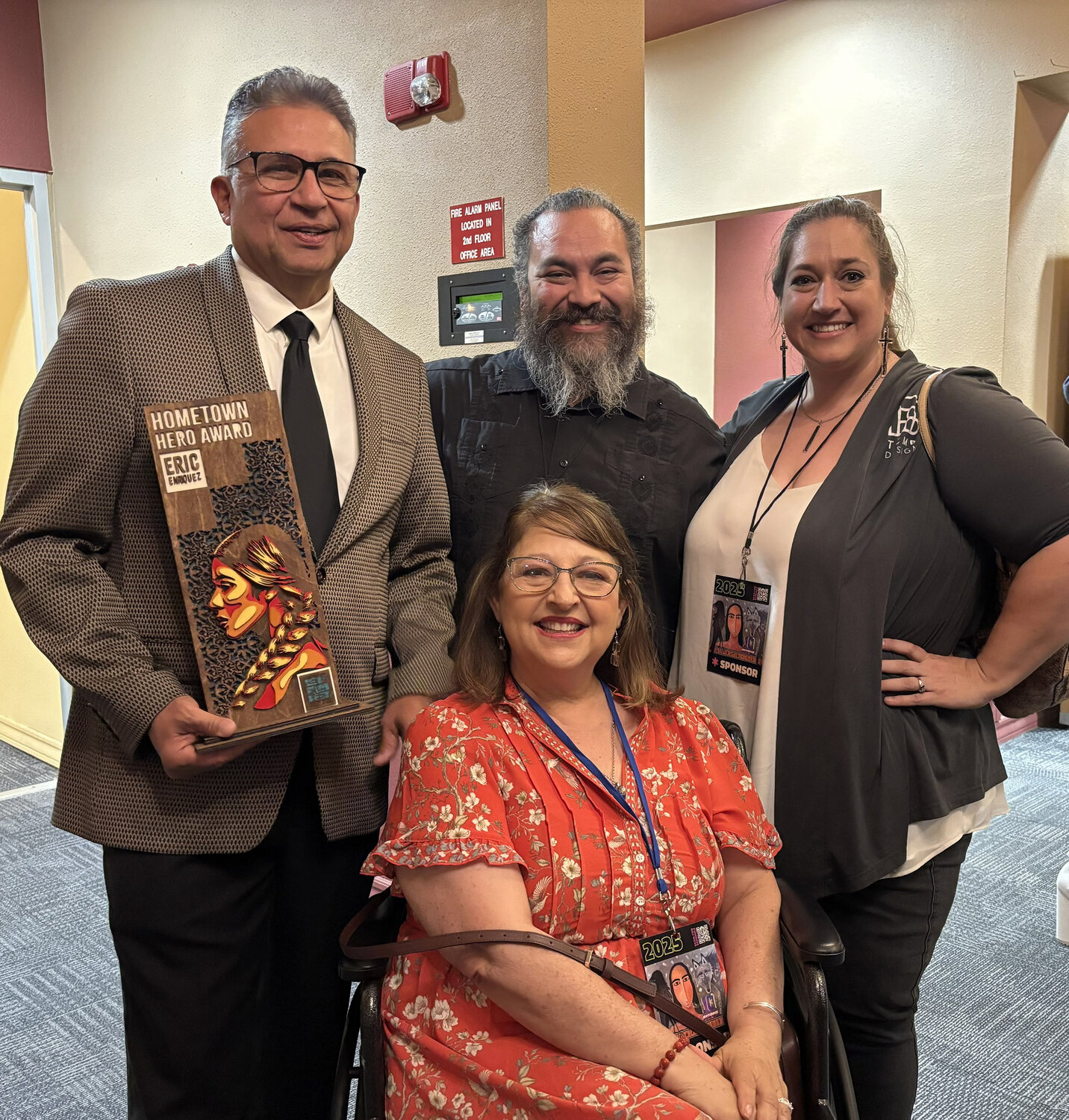
“Last year, after seeing the artwork on the poster, I decided to do the large ones for the people coming in, as a woman that looked indigenous to this area,” Basaldua said. “So, I created artwork of this woman from a side view with a braid because braids seem like a simple thing that gives a Hispanic Native American heritage of the area very quickly.”
From there, the process becomes layered — literally.
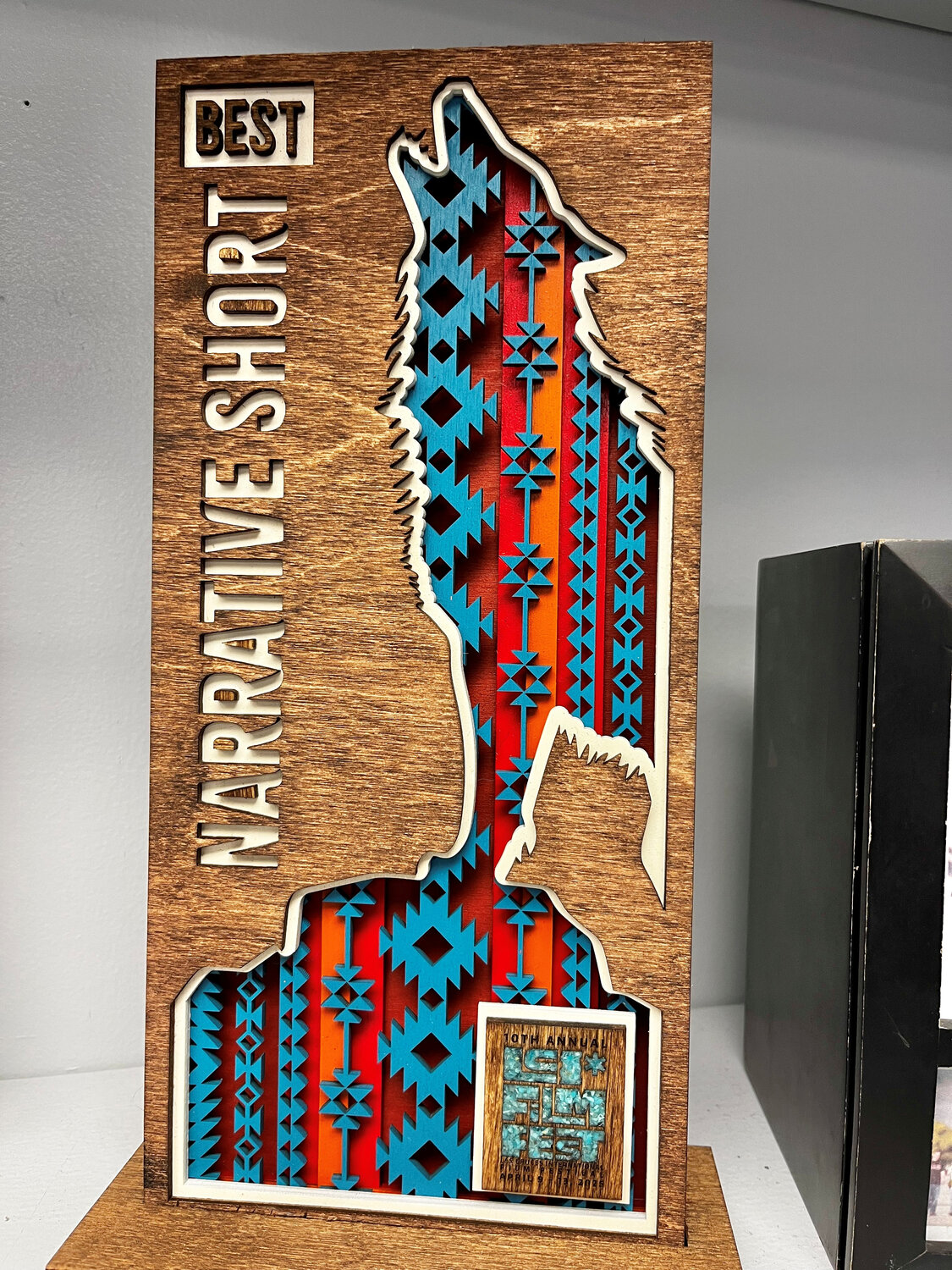
Basaldua digitizes the design, engraves it, builds it from laser-cut wood, paints each layer, inlays turquoise and crushed glass, and finishes it with resin. The result is something that feels less like a trophy and more like a sculpture.
For the individual film awards, she created a complementary design featuring a wolf, tying the pieces together thematically.
But the process is as demanding as it is creative.
“I batch them when I do my laser cutting and then my husband and will sit and we'll sand everything and stain it,” she said. “I want to say there were 17 or 18 of the film awards and then there were five last year of the big awards. It takes several weeks to do all of them.”
This year, the vision continues to evolve.
Basaldua is working toward a design that can become a recognizable staple of the festival — something consistent year to year but still rooted in place.
The concept draws from the landscape itself: the colors of the New Mexico sky, layered forms that suggest mountains or dunes, and inlays that catch the light.
“It will look really beautiful for each award and we’re adding custom things that really represent the area that we can do every year but it's definitely unique to this festival,” she said. “We absolutely are influenced by everything around us, with our jewelry and everything we create. And with everything, we want to make it uniquely ours.”
For Basaldua, the reward comes in the reaction.
At last year’s ceremony, she watched as recipients took the stage and held something entirely different from the standard plaques and acrylic trophies common at film festivals.
“It’s great to see that, which then transcends them realizing that we put time and effort to acknowledge their work and we wanted that to show through in their award, that it was special and that what they did means something and that their award reflects that,” she said.
Marks saw the same thing — and knew they had created something distinct.
“I love Theresa, and loved her work,” he said. “We've grown to be so big now that we're trying to elevate the arts in Las Cruces across the board. Last year was the first year she did the awards. They were really sculptures. I remember Helen Hunt got hers and she said, ‘This is as nice as some of the others I've gotten.’ I said, ‘including the Oscars?’ And she said, ‘It's going right next to the Oscar.’ That was kind of neat.”
As LCIFF continues to grow, those details matter.
“Theresa is an artist, so Theresa is a big part of that because she's creating sculptures that are going to the filmmakers, and our award winners like Michael Rooker and Shane Black and Bruce Davison,” Marks said. “It also really elevates the film festival because instead of getting a standard acrylic or brass award that most festivals do, we have a handmade piece of art that really stands out.
“We’re constantly trying to figure out ways to elevate our event and to stand out from other festivals, and Theresa's awards are one way we do that.”
At most film festivals, the award is the end of the story.
In Las Cruces, it’s part of it. A reflection not just of the film being honored, but of the place doing the honoring — layered, handmade and rooted in the culture that inspired it.


