





At 595 South Foch Street in Truth or Consequences, a decades-old lumber mill is slowly being reborn. Purchased by sculptor Otto Rigan and his wife, Stacy Blum Hay, the sprawling structure is being transformed into a live/work art space and gallery, a testament to the hands-on approach that has defined Rigan’s career.
“There’s enough space to do everything,” Rigan said of the mill, one of the town’s earliest, once a cat litter distribution warehouse and, at another point, a storage facility for dozens of taxicab hoods. “We’re doing as much of it as we can handle ourselves.”
Rigan’s journey to this point has been a winding one, shaped by a restless curiosity and a lifelong engagement with the material world. Born at Edwards Air Force Base in Roswell, he was exposed early to a quirky blend of science, history, and artistry. His father served in the Air Force, while his mother encouraged creativity at home, leading him and his siblings in building miniature pueblos from mud and straw.
A formative encounter with the renowned New Mexico artist Peter Hurd (1904-1984) left an indelible mark.
“Going to Peter Hurd’s studio…you realized that you could be an artist,” Rigan recalled.
As a boy, he watched polo games at Hurd’s house, saw Henriette Wyeth Hurd (1907-1997) at work, and felt the tangible presence of tools and practice that made artistry real. Other early influences included the Italian-born sculptor Benny Bufano (1890-1970), whose monumental works across the Bay Area Rigan encountered in his early teens.
“His work was always engaging and somehow warm,” Rigan said.
The urban scale and formal rigor of Bufano’s sculptures left a lasting impression on the young artist, even as he gravitated initially toward painting rather than sculpture.
At 14, Rigan began academic drawing studies at the California College of Arts and Crafts in Oakland, traveling a 240-mile round trip by bus each weekend from home — a demonstration of discipline and dedication that would become a hallmark of his practice. After starting college at California State University, Stanislaus, he returned to CCAC and later completed an apprenticeship in the traditional atelier system at the Accademia di Belle Arti in Florence, Italy.
Back in the U.S., he worked backstage at Her Majesty’s Theatre in London’s West End before ultimately returning to the American West, drawn by its physical expansiveness and creative possibilities.
Rigan’s entry into sculpture was unconventional. Rather than learning the classical methods of carving stone or modeling clay, he absorbed a pragmatic, architectural understanding of materials during an apprenticeship in architectural stained glass at Cummings Studio near San Francisco. This exposure to glass as a medium for spatial and structural expression later became central to his work.
His early explorations led to his first book, “New Glass” (1976), and a series of publications on alternative architecture and glass as a medium, including “From the Earth Up” and “The Palace Doors of Abu Dhabi.”
The discovery of New Mexico Travertine in Belen became a turning point.
“The father, who had been in masonry his whole life, spent two hours with me…explaining different rocks, explaining how you cut them,” Rigan recalled.
There, using state-of-the-art saws and other tools, he learned to manipulate stone not just as raw material but as an extension of architectural space.
“I didn’t touch the tools at first,” he said. “By the second day, he handed me the keys to the front door. They entrusted me with any tool they had. It was a leap of trust that basically made my career.”
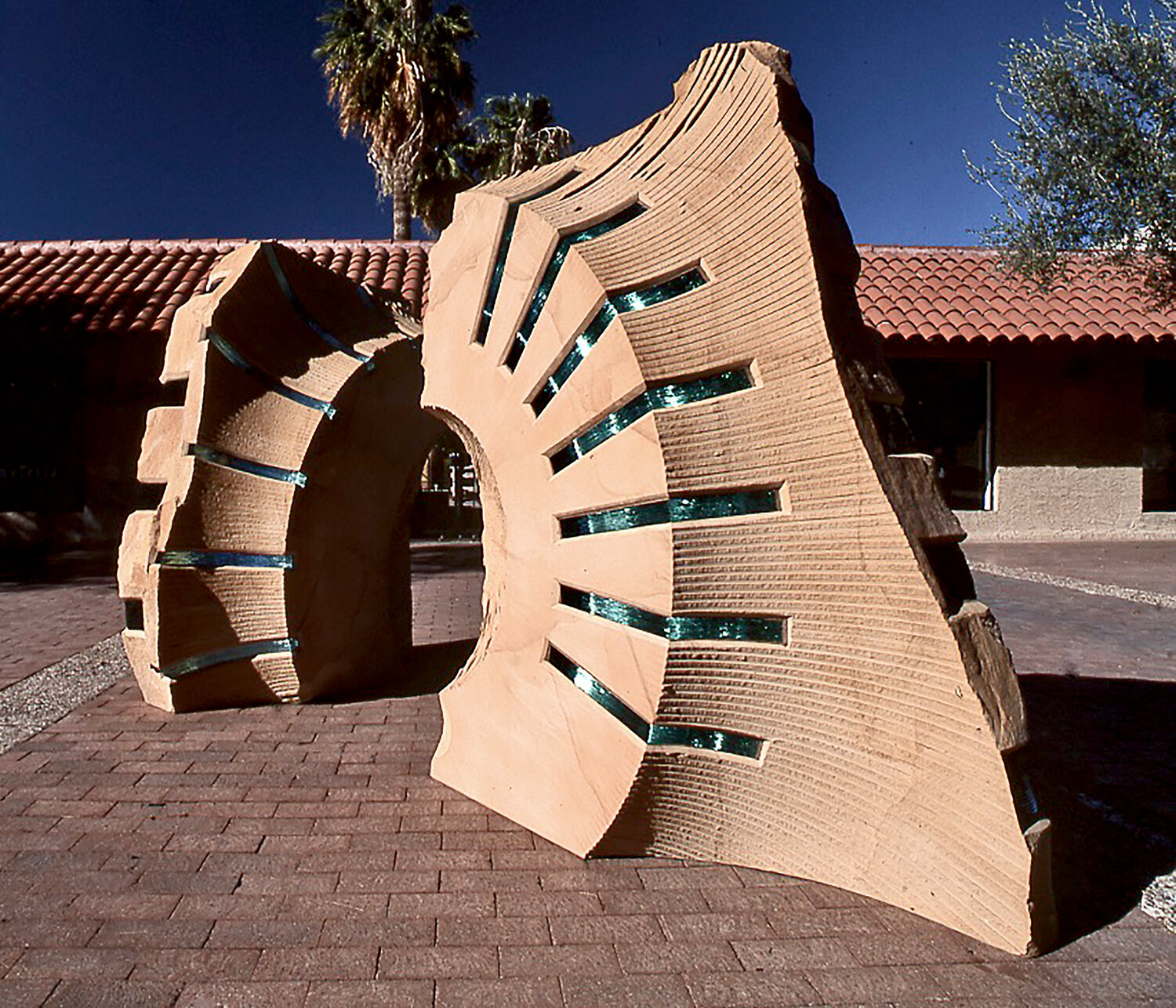
From limestone to sandstone, his relationship with the Lardner family and the Belen quarry has sustained decades of sculpture, whether for public installations, private collectors, or experimental works.
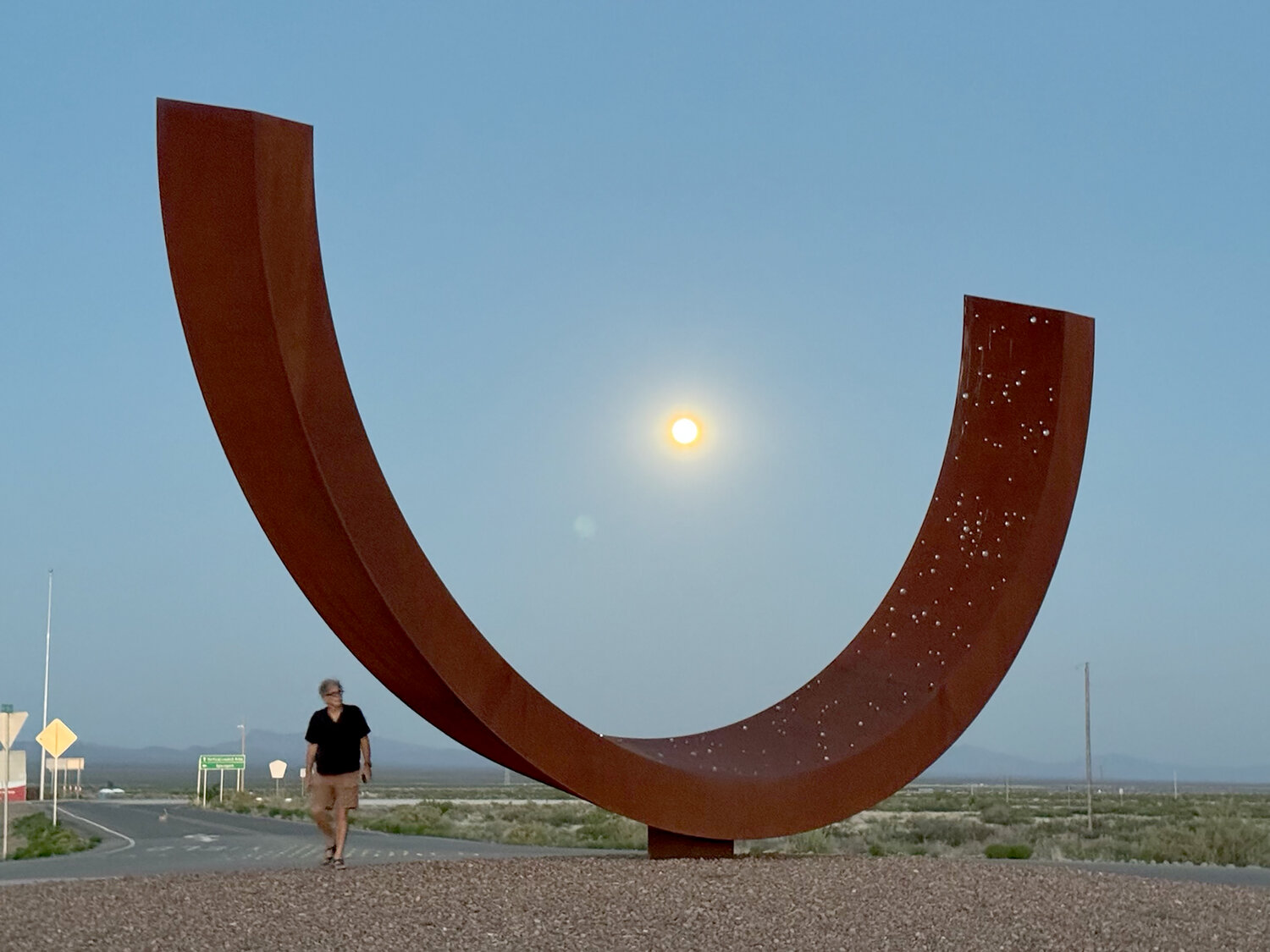
Recent projects illustrate Rigan’s fascination with scale, material, and light. GENESIS, his monumental steel and cast glass sculpture at Spaceport America, spans 40 feet wide, 23 feet high, and five feet deep.
“That’s how I really found out about Truth or Consequences,” he reflected, noting the piece’s shifting patina and interaction with natural light.
Meanwhile, a dense 3,000-pound limestone sculpture commissioned by a Tucson collector became a personal test of resilience after a serious injury. Three and a half years ago, Rigan fell from a rooftop, fracturing five lumbar vertebrae and losing an inch and a half in height.
“I had to learn how to work with a lot less capacity,” he said.
Yet he persevered, completing the piece and continuing to push his practice forward.
Rigan approaches sculpture as a negotiation between material, form, and environment. He describes glass as a medium of light, tension, and fragility, while stone provides weight and permanence. In his studio practice, he often hand-cuts and laminates glass atop stone, creating intricate topographical relationships that respond to the space they inhabit.
“Glass always responds to light,” he said. “I want to try to take advantage of the sculpture in the light where it sits. Since it’s probably not going to get moved, I need to get it right.”
His early fascination with architecture continues to guide him. Rigan’s works have ranged from residential installations to public-scale projects, including courtyards, memorials, and gateways. He also collects art from around the globe: Tibetan Buddhist ritual objects, Mongolian thangkas, shamanic tools from Panama’s Kuna people, and African chairs and stools, particularly from the Dogon of Mali.
“I’ve always been intrigued by people pushing boundaries, doing it out of compulsion and need,” he said.
Despite a career spanning decades and continents, from Japan to Mexico, the American Southwest to New York, Rigan remains rooted in the intimacy of place and process. His latest focus is his imminent studio and gallery in Truth or Consequences, where the couple continues the painstaking renovation of the old mill.
“We’re just now getting the next project going,” he said. “It’s all about the people and the exact space. The glass, the stone, the light — it will all come together right here.”
For Otto Rigan, art is not just material, it is a dialogue between vision, space, and the act of making itself. And only a few steps from Main Street, that dialogue continues to unfold, stone by stone, slab by slab, and glass panel by glass panel.


